

The Three Disappointments
Or why your AI investment isn't working (yet)

Most companies are failing at AI adoption. Not because they’re not investing, but because they’re not yet investing in the right thing.
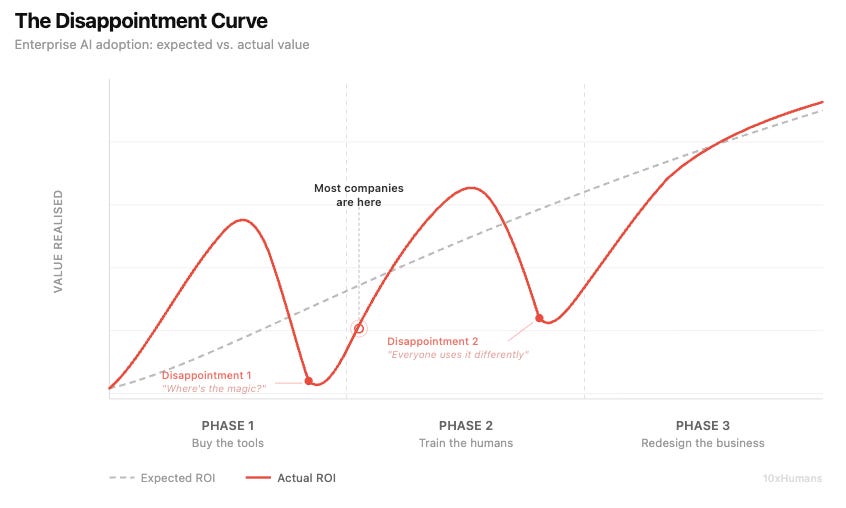
We’ve spoken to about 75 founding teams of AI services businesses (training, consulting, implementation) across Europe and the US over the past nine months, alongside a growing number of the companies buying their services. A clear pattern is emerging. Enterprise AI adoption isn’t one decision and action. It’s a cycle of investment, disappointment, and course correction, and most mid-market companies are stuck somewhere between the first two loops.
Here’s how it plays out.
Phase 1: Buy the tools, issue the mandate, wait
The pressure to “do something with AI” hit mid-market companies hard in 2024. Leadership responded by buying stuff: LLM licences, subscription upgrades to AI-enabled applications, token budgets. They issued mandates to use these tools, to be more productive, to find cost savings, and report back.
Then they waited for something magical to happen.
In most cases, it didn’t. Usage was shallow. Adoption was patchy. Nobody could point to ROI because nobody had defined what ROI was supposed to look like. The tools sat there, technically available, practically underutilised.
First disappointment.
Phase 2: Train the humans, watch them diverge
The more thoughtful companies went back and diagnosed the problem. We didn’t teach anyone how to use this stuff - no wonder. So they bought training: discovery workshops for management, upskilling programmes for employees, e-learning content for everyone.
This helped, sort of. Employees started using the tools. But they used them in completely disconnected ways. There was no coordination, no alignment with company goals, little effect on actual business processes. Some people increased the volume of stuff they generated but quality declined. A few became genuine super users, doing things nobody had anticipated, but hit a ceiling when they needed to connect to enterprise systems or integrate with other departments.
Many found clever ways to meet the mandate to use the tools without benefiting the business.
What you get is a bifurcation. The employees who figured out how to get the most from the tools, and the employees who figured out how to do the least with them. Both groups are “using AI.” Only one is creating value.
Second disappointment.
Phase 3: Redesign the business, brace for years
A small number of companies are now reaching the uncomfortable conclusion that training isn’t enough either. The problem isn’t that individuals can’t become more productive. It’s that the business processes they’re being productive within were designed for a world pre AI.
This phase means stepping back and mapping how the business actually operates, asking why things are done this way, and redesigning from the ground up. It’s not glamorous work. It’s process analysis, role redesign, organisational rewiring. The kind of consulting engagement that takes quarters, not weeks.
And the hardest part isn’t even the upfront analysis. It’s the change management. Rewriting someone’s job description is easy, but getting them to actually work differently takes time, usually years.
Every historical precedent says so. The introduction of electricity into factories took 30 years to produce productivity gains, largely because factory owners kept arranging machines the same way they’d arranged steam-powered equipment. The resistance wasn’t technical. It was organisational, ie human.
The same is true now. It doesn’t matter how powerful the models get. GPT-6 won’t make your middle managers comfortable with a reorganised reporting structure. The bottleneck was never the technology. It’s the people.
The exception that proves the rule
There is one domain where adoption is genuinely faster: software engineering.
Developers were already collaborating through platforms like GitHub. They were already used to integrating new tools into and testing new coding interfaces. The culture was tool-native before AI arrived, so AI slotted in with relatively little friction.
The result is a compression of roles. Product management, product design, and engineering are blurring together. Everyone’s getting more senior. The junior developer role, as traditionally conceived, is disappearing. Not because the work is gone, but because the floor has risen.
This is real. But it’s the exception, not the template. Most knowledge work doesn’t have the collaborative infrastructure, the iteration speed, or the cultural readiness that software development had before AI showed up. Assuming the rest of the organisation will follow the engineering team's lead is a mistake we've seen before — with agile, DevOps, OKRs, design thinking, and lean startup — basically every engineering-first practice that HR tried to generalise into a company-wide initiative.
The Dorsey shortcut
There’s a fourth approach worth noting, though I’m not sure it deserves the dignity of being called a “phase.”
Some CEOs are skipping change management entirely. Fire first, redesign later. The most visible example cut 40% of a 10,000-person workforce and is now thinking about how to restructure what’s left. The logic, presumably, is that it’s easier to redesign an organisation when there’s less of it to redesign.
It’s worth separating the signal from the noise here. Estimates suggest that 90% of the layoffs attributed to AI over the past two years were actually driven by economic contraction, post-pandemic corrections, or plain old overhiring. AI makes for better PR than “we hired too many people in 2021.” The Dorsey shortcut isn’t really an AI strategy. It’s a correction wearing an AI costume.
That said, I suspect we’ll see more of it. For publicly traded companies under pressure to show AI-driven efficiency gains, cutting headcount is the fastest way to move a number on a slide.
The human-positive bet
Here’s where I’ll show my hand.
At 10xHumans, we’re betting that the companies that win long-term are the ones using AI to grow, not just to cut. Cost-cutting is a one-time gain. You can only fire your workforce once. But building new capabilities, entering new markets, serving customers in ways that weren’t previously possible: that compounds.
The mid-market companies going through these three disappointments aren’t failing. They’re learning. Each phase gets closer to the real opportunity, which isn’t “how do we do the same thing cheaper?” but “what can we do now that we couldn’t do before?”
The companies that ask that second question, and have the patience to redesign around the answer, are the ones worth backing. The models will keep getting more powerful. That’s someone else’s problem to solve. The human side of adoption, the training, the process redesign, the change management, that’s where the value is created. And that’s where the work is.
Thoughtful piece Max. The three phases you describe resonate strongly.
Leading analytics teams for many years, I often saw a similar pattern well before AI. Organisations would invest in tools and training, but the real challenge was translating insight into coherent processes and decisions that the business could actually act on.
What feels different now is the scale. AI dramatically increases the volume of signals and outputs, which makes the human layer of curation, translation and organisational integration even more important.
One reflection your piece sparked for me is the difference between training and coaching in this transition. Training helps people learn the tools; coaching helps teams rethink how work, judgment and decision flows evolve around them.
In many ways AI adoption feels less like a technology rollout and more like tending an ecosystem — where sustainable growth needs to be curated, translated so it can travel, and integrated so the whole organisation grows well together.
Appreciate you sharing these observations — they invite exactly the kind of reflection leaders and teams need right now.
Great article Max!