

The Experimentation Phase Is Over
Now comes the hard part

88% of organisations are using AI. 74% of CIOs say they’re breaking even or losing money on it. Both stats come from reputable sources. Something doesn’t add up.
At one end we have the “AI is everywhere, and it’s working” view, mostly from strategy consultancies. McKinsey reports that a small but growing group of “high performers” claim more than 5% of their company’s EBIT comes from AI. BCG gives us the worker-lens echo: 72% of professionals say they regularly use it, with adoption above 85% in markets like India.
At the other end is the “actually, ROI is murky and workers don’t feel the impact” view. A Gartner survey found 74% of CIOs say their organizations are breaking even or losing money on AI once full costs are included, and Deloitte describes AI as “underutilized” with limited clear revenue lift.
Most recently two vendor surveys help explain the contradiction. Section’s survey of 5,000 knowledge workers finds 70% stuck at “AI experimenter” level, less than a third saving four hours a week or more, 24% saving no time at all, and 40% saying they’d be fine never using AI again (!).

Workday’s global study suggests why. Although 85% of employees save 1–7 hours weekly with AI, roughly 37% of that time gets clawed back correcting low‑quality outputs, and only 14% consistently realise net‑positive outcomes once rework is factored in. Call it the “AI tax.”
What emerges for me is a stark gap – some perception, some reality – between managers and workers.
The C‑suite seems convinced things are going great. In Section’s report, 81% of executives say their company has a clear, actionable AI policy. Just 53% of individual contributors agree. 80% of C‑suite respondents say tools are easy to access, versus 46% of knowledge workers. Three‑quarters of executives describe themselves as excited about AI, 94% say they almost completely trust its output (eek!), and a majority use it daily.
Yet Section’s numbers suggest 97% of the workforce are either AI novices or basic experimenters. Heavy users often pay that AI tax of rework that quietly erodes much of the promised productivity.
Why the disconnect? Several reasons.
Slack and autonomy matter. The more flexibility in your role the more you can experiment with tools. Workday’s “Augmented Strategists” tend to be mid‑career professionals in roles like IT and marketing who have room to tinker, apply AI to pattern recognition and decision‑support, and benefit from more generous training budgets. By contrast, individual contributors have the least access to tools, training and reimbursement, even though their work is often the most repetitive and automatable.
Middle managers are too busy maintaining legacy workflows to redesign them. Workday reports that in most organisations, fewer than half of roles have been formally updated to include AI skills. In struggling firms that drops below 25%. Section describes a “use‑case desert,” where 26% of knowledge workers say they don’t have any work‑related AI use case, and 60% are stuck on beginner tasks like summarising notes or rewriting emails.
Senior roles are structurally better suited to AI’s strengths. Executives spend more of their time on meeting prep, narrative building, synthesizing information and communication. These are tasks where probabilistic, “good‑enough” draft outputs are useful and easy to refine. By contrast, junior workers are often executing fixed, compliance‑sensitive processes (HR, operations, customer support), where outputs must be precise. GenAI is far less useful here than their existing, deterministic, systems.
Permissions and budget skew upward. Only 32% of individual contributors report clear access to AI tools, compared with 80% of the C‑suite. The more senior you are, the more likely you are to be allowed to connect AI to company databases and applications, and to receive training and support to do it.
We conflate feeling busy with actual productivity. Surveys rely on self-report data. We have some good research involving software engineers that highlight a perception gap issue. One randomised trial of 16 experienced software engineers found developers predicted AI tools would make them 24% faster. When researchers measured actual task time, AI-assisted tasks were 19% slower.
My favourite stat though is one of the few purely numerical ones that hints at where the market is heading: the Ramp AI Index (posted by Apollo), which tracks purchases of AI models, tools and licences by US companies, shows purchases levelling out at about 47% of companies, suggesting that the huge burst of initial experimentation is over:
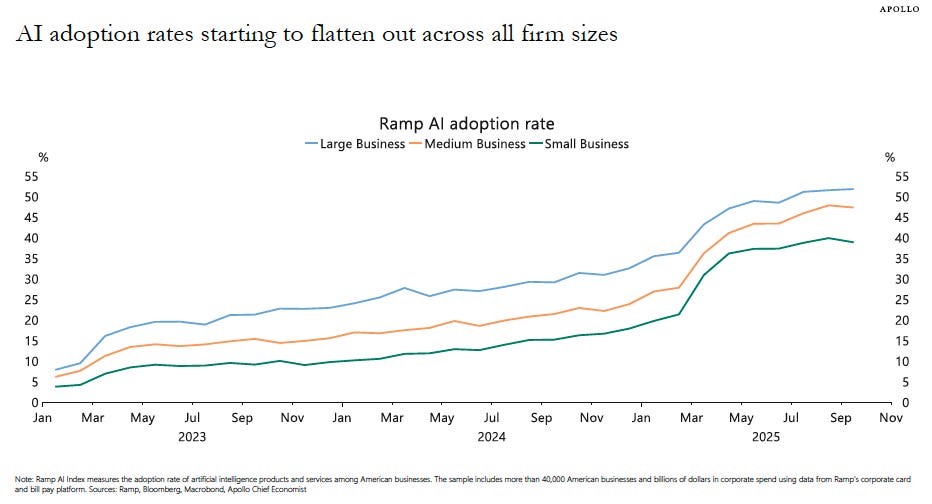
So where do we go from here? If adoption won’t accelerate through more software purchases, what remains is helping companies use what they already have. That means training for all workers, not just senior ones. More important, it means shifting from the low-hanging fruit of automating individual tasks to the harder work of redesigning processes entirely.
The experimentation phase is done. Now comes the unglamorous part: making it actually work.